Wednesday, December 24, 2008

MONEY SUPPLY


Money supply can be defined as the aggregate supply of money in circulation, which comprises of currency with the public and demand deposits with the banks. It is the liquid assets held by individuals and banks. Some economists consider time and savings deposits to be part of the money supply because such deposits can be managed by governmental action and are involved in aggregate economic activity. These deposits are nearly as liquid as currency and demand deposits. Other economists believe that deposits in mutual savings banks, savings and loan associations, and credit unions should be counted as part of the money supply. Money supply is also known as money stock or monetary aggregates

There are several measures for the money supply, such as M1, M2, and M3. The money supply is considered an important instrument for controlling inflation .The Reserve bank of India has adopted four concepts of measuring money supply. They are M1, M2, M3, &M4.
The measure of money stock designated by M1 is usually described as the money supply. The components of money supply are currency with the public ie notes in circulation and deposits. It is the narrow measure of money, which is used for everyday expenditure.
Another measure of the money supply is M2, which is the total of M1, savings and small time deposits, overnight repos at commercial banks, and non-institutional money market accounts. M2 is a key economic indicator used to forecast inflation. M2 is also a broad money concept.
M2, plus large time deposits, repos of maturity greater than one day at commercial banks, and institutional money market accounts constitute M3 is also known as broad money concept. This includes net time deposits (fixed deposits), savings deposits with post office savings banks and all the components of M1.

The monetary policy and credit policy addresses the control of money supply. These policies are aimed at increasing or decreasing the money supply. The Reserve Bank of India announces these policies on a half yearly basis, at the commencement of each half-year. The major tools use by the RBI to control the money supply are the bank rate, variation of reserve ratios, open market operation and moral suasion.

When RBI increases or reduces the bank rate, the funds become dearer or cheaper to banks. This either eases the market with more money supply or tightens the market by withdrawing the excess liquidity in the market. The change in the reserve ratios such as Statutory Liquidity Ratio or Cash Reserve Ratio also reduces or increases the funds availability. Statutory Liquidity Ratio represents the investments made by the banks in unencumbered securities approved by the RBI. Under open market operations, the Reserve Bank auctions the treasury bills or buys the bills back so that the excess liquidity in the market would be absorbed. Similarly the buying back of the securities will enable the banks to get funds from the market. The moral suasion is a non-monetary measure. It is psychological pressure applied on the activities of the banks, which ultimately would either withdraw or supply money to the market.

Sunday, December 21, 2008

GLOBAL FINANCIAL REGULATORY AUTHORITY- WILL IT BE A SOLUTION FOR FUTURE FINANCIAL CRISIS?

History tells us about the existence of financial system in the world enabling the countries to exchange their currencies. The Bimetallism prevalent prior to 1875 gave way to the Classical Gold Standard. The World War I brought an end to the age old British dominance in the World money management. The Great Depression in 1931 called for a central regulatory system to ensure economic stability in the countries across the world. Thus the move started in 1944 by 44 countries in Brettonwoods in UK brought two Institutions to manage the global financial word. While International Monetary Fund (IMF) was expected to provide assistance to come out of Balance of Payment crisis, the sister institution International Bank for Reconstruction and Development (IBRD), popularly known as World Bank, took the responsibility of extending financial aid to build up ruined economies across the world. The lack of confidence in the British Raj in management of International Monetary System consequent to the failure of the Classical Gold Standard led to replacement of Great Britain by United States on the control. The dominance of US can be witnessed visibly in the Brettonwoods System which had thrust upon the responsibility of conversion of Dollar into Gold at a specified rate which was revised thrice. The failure of US to meet their commitment was the reason fro the failure of Brettonwoods System.


The 1922 Geneva Economic Conference provided the platform for giving birth to an International Banking Institution to bring co-operation among the Central Banks across he world. Thus the Bank for International Settlement (BIS) was established in 1931 with its Head Quarters in Geneva to promote central bank co-operation.


The Latin American Crisis and the East Asian Currency Crisis in the 1990s were ample evidence for the failure of all the above institutions in managing the International Financial System. If we closely examine the administration of these bodies, we can clearly see the US dominance everywhere. Thus the US has grown to the level of a major economic power capable of deciding the fate of the economies in the world because they are the custodian of the wealth of these economies. Though European Monetary System emerged as an alternate mechanism and Euro was positioned against US Dollars, so long as US Dollar remains as the intervention currency and the foreign exchange reserves of countries are maintained US Dollars, the economic power of US is difficult to be controlled. After dwindling for quite a long time since its inception, Euro is getting stabilized only now.


The current financial crisis also was triggered by the US economy. The US subprime crisis was the root cause for the meltdowns of banking institutions and loss of jobs, homes and security for millions in the world. Still they continue to be the custodian of the wealth of economies in the world. Now a new demand has emerged out of the discussion among the world economists for constitution of a Global Financial Regulatory Authority. Prof. Joseph Stiglz while delivering the Lakdwala Speech in New Delhi had put forward this suggestion as a solution to check future meltdowns. At the same time he had criticized the economic policies of US administration and had squarely blamed them for the present crisis.


If we examine the role of IMF, World Bank and BIS in preventing a meltdown as that happened in the previous years, we have to accept the fact that these institutions have miserably failed in preventing a crisis. I feel that they were silent spectators of the crashing of markets. The reasons, I feel, could be the US dominance.


Now it is not clear what would be the shape of a new regulatory authority. Can the US hands be kept out of this agency? If US dominates this one also will it not be another institution like IMF or World Bank? Being the holder of the major portion of the wealth of nations how can one keep away US from the proposed authority? In my opinion, the countries have to shift their reserve currency from US Dollars to Euro and use Euro as the intervention currency in order to prevent future financial crisis. With weak banking system and lack of control mechanism US can create more havocs in the world financial markets. Unless US is kept out of the scene no new authority can effectively prevent future meltdowns.

Thursday, November 6, 2008

GLOBAL FINANCIAL CRISIS AND INDIAN ECONOMY

Financial Crisis is not a new phenomenon in the modern world. The major financial crisis which brought down the economies of Latin American countries such as Brazil, Mexico was the first experience in the modern era. The IMF and US administration lifted these economies through an expensive bail out plan. The second experience was from the East Asian Financial Crisis triggered by the devaluation of Thai Bhat in July 1997. The crisis pulled down eight South East Asian Countries commonly known as Asian Tigers. The countries were Malaysia, Singapore, Hong Kong, Taiwan, Korea, Indonesia, Philippines and Thailand. The melt down drastically brought down not only the stock and currency markets in these countries but the markets in other developing countries such as USA, Japan etc. were also affected on account of the contagious effect. Fortunately Indian economy was spared from a major crash thanks to the conservative approach our administrators had taken with regard to opening up of our economy to the external world as also the insulation mechanism implemented by sterilizing the cash flows from abroad. But the current crisis emanated from the US sub-prime lending became costly to Indian investors as well due to the steep fall of stock prices and weakening of Indian Rupee.

Indian money market was experiencing severe liquidity crunch on account of the heavy FII out flows consequent to the financial crisis abroad. However, we were quick in reacting by initiating appropriate qualitative as well as quantitative measures to arrest the steep fall and rebuild the lost confidence. Reserve Bank of India pumped around Rs.125000 crores to the market in three tranches by reducing the SLR, CRR and Repo rates considerably. The worst affected areas were real estate and SME sectors due to the reluctance of bankers to lend. The RBI initiative enabled the banks to reduce their lending rates by 75 bp and many banks declared lowering their lending rates, especially to home loan sector. The relaxation in the norms for Participatory Notes was another initiative to boost up FII inflows. Another noteworthy initiative was the increase in foreign investments to 49 per cent from the current threshold limit of 26 per cent for investments in insurance sector. On the qualitative side the Finance Minister and Prime Minister assured the country that our banks and markets were safe and the phenomenon was only temporary. Besides RBI on its part assured liquidity to the banking system and certified the safety of Indian Banks. These measures could ease the tension to a great extend and the market started rebounding as witnessed by the upward journey of stock indices and strengthening of Indian Rupee against dollars. The quarterly results of India Inc. also indicate growth potentials.

However, the buoyancy does not last when we look at the employment sector. Globally, the companies have started downsizing consequent to the financial crisis in order to reduce their cost of operations. The Indian counterparts, especially IT companies and BPOs have to follow the path because their business would come down drastically on account of the slow down in overseas economies. The major part of outsourcing is from US and the bad shape of US economy has already spread black shadow on the IT companies. While large companies like Infosys are trying to avoid a huge downsizing, smaller one has no option and hence started retrenchment. The Prime Minister had appealed the industry captains not to retrench their employees consequent to the meltdown; the Indian branches of overseas companies have already started dropping the employees. Recently American Express showed the doors to their employees in India. The loss of employment may create financial and psychological problems to a large population in the country unless they are suitably redeployed.

These events need not melt down our confidence; at the same time we should not be complacent also. The BRIC report has identified India as one of the major economy in the world by 2050. The phenomenon what we now witness is only temporary. The managers of our economy are not simple politicians but they are able and eminent economists and business executives who are capable of envisioning eventualities and initiate timely corrective measures. Though the industrial production has slowed down now, it will rebound in the ensuing financial year. The agriculture production also is showing positive trend and as such the economy will regain its lost momentum with in a short span of time. The inflation is expected to come down to 7 per cent by February next. The crude prices are falling and are expected to touch $55 per barrel. If the trend continues, we may expect a further decline in inflation to 5 per cent by 2010. The employment opportunities will also go up by the above period. The capital market is expected to perform in a better manner because of the lowering of interest on bank deposits and availability of more funds from banks. However, the ensuing election to the Parliament may bring new political equations which can greatly influence the future progress of the country. Let us hope that the economic agenda of the country will not be disturbed by the election process and change of administration.

Sunday, October 5, 2008

FINANCIAL EXCLUSION

Financial exclusion can be defined as the process of denying access to financial services to a section of the population. Financial exclusion has become a major concern of many of the countries. A study conducted by Elaine Kempson and Claire Whyley of the Personal Finance Centre, U.K revealed that one and a half million households lack even the most basic financial products and another 4.4 million are on the margins of financial services provision. Various reasons have been assigned for financial exclusion. Some of these reasons are:
Lack of awareness of financial products and services among the households
Lack of sufficient income by the households to save.
Unemployment among the households or underemployment
Young householders who are yet to take decision on availing of financial services
Elderly persons above the age of 70 who depend more on cash
Denial of access to the financial services due to the stringent conditions imposed by agencies providing these services.
Low savings or no savings
Lack of assets
Poor financial habits resulting into indiscriminate spending.
Psychological disabilities
Feeling of being outcast form the mainstream of financial services
Indigenous and ethnical issues
Geographical inconvenience
Lack of time
Computer illiteracy or lack of PC/internet access
Availability of alternate products and services.
Alternate suppliers providing services.

The other phenomena related to financial exclusion are financial illiteracy, financial exploitation and financial discrimination. Financial illiteracy is experienced not only in the rural sector but in some sections of the urban population also, especially among the newly employed youth class. By financial illiteracy we mean the lack of adequate knowledge on of financial services and products, their uses, scope and potentiality. The second phenomena, financial exploitation is the result of either non-availability of organized form of financial services sector or people shy away from the organized sector. There are still people who deposit money in unregistered financial institutions and lose their hard earned savings forever. Another area of concern is the tight grip of loan sharks over the farmers and small businessmen. Many times these people hesitate to go to the organized sector in view of the cumbersome procedures or number of formalities to be observed providing opportunities to unorganized sector to exploit the poor and down trodden. The third one financial discrimination happens when a certain class of customers enjoys privileges when the others are denied of such facilities. whereas in some other cases they proceed with recovery action. In view of these reasons also many times people hesitate to avail of the financial services.

Generally the poor, socially underprivileged, disabled, elderly men, children, women, uneducated, ethnic minorities, unemployed etc. class of people are subjected to financial exclusion.


Financial exclusion imposes significant costs to individuals, their wider neighbourhood and the society at large. Some of the important costs associated with financial exclusion to individuals are higher charges for basic financial transactions and credit, no access to certain products or services, lack of security in holding and storing money, barriers to employment, entrenching exclusion

Financial exclusion brings costs to the society as a whole. Some of the costs to the society are contributor to child poverty, costs to the benefit system, link to social exclusion.

Saturday, October 4, 2008

REAL ESTATE FINANCE-IS IT ANOTHER BUBBLE?

The banks have started rethinking about their exposures in real estate. Punjab National Bank has already frozen their loans to real estate. The global melt down in the financial markets consequent to the sub-prime lending fiasco in the US market has sent lightning through the spine of bankers. No doubt the bubble is taking its shape to burst unless further growth is prevented. The lessons from East Asian Countries are good evidences of real estate meltdowns consequent to financial market crisis. It would be interesting to take a journey through the risky territories of this high profile high return credit portfolio of banks.

Traditionally, real estate finance has been a lucrative area not only to commercial bankers but even for the indigenous bankers and village money lenders. During olden days farmers used to mortgage their land with the Zamindars by simply handing over the title deeds and signing a promissory note. The passing of Transfer of Properties Act, 1882 gave a legal frame work for transfer of properties and prevented illegal transfers. The Act extensively covers mortgages, leases and exchanges. Sections 58 to 104 of the Act well explain the legal requirements to make a mortgage effective. Chapters I and II of the act also deal with the requirements to be complied with for making the transfer of properties effective. A bank which extends real estate finance against the security of landed property usually ensures that all these legal requirements are complied with prior to sanctioning the loans. Still the banks run into various risks while financing the real estate sector.

One of the major risks is the legal risk. The legal risk arise out of the non-enforceability of the documents executed by the borrower. This situation may arise due to various reasons such as lack of proper title, non-compliance of legal formalities, inadequate stamp duty, incompetency of the owners to mortgage, restrictive covenants in the document of title to property etc. Banks do exercise vigilance against the legal risk by getting the documents scrutinized by the bank’s legal counsel and further scrutiny by the banks’ own legal officers. Despite all these precautions there are numerous instances where the borrowers could defraud the banks. In some cases even the documents presented happened to be fake which were made with the connivance of the officials of the Registration Department. One of the precautionary measures which banks take is by obtaining non-encumbrance certificate from the Registration Department. If the loan is taken against a registered mortgage, the non-encumbrance certificate will show the details of mortgages. But the mortgage by deposit of title deeds will never appear in the non-encumbrance certificate issued by the registration department. Though the original documents are held by the bank which financed the loan, the borrower manages to get another copy with the help of the officials in the registration department and produce this document before another bank for raising loans. (In Tamil Nadu, a few years ago even the Registrar was a party to such fraud. In Kerala a number of fake Pattayams issued by the revenue officials were confiscated during a raid conduct by the government last year.) When the documents are proven to be fraudulent, the financing bank loses the chance of exercising its right over the property.

Another case of legal risk is certain restrictive covenants in the original document. For example in a Partition Deed, there may be clause preventing the alienation of certain part of the property which is set apart for a specific purpose. But in subsequent documentation this portion may be conveniently omitted without producing the original Partition Deed stating that the original held by another family member and producing a certified copy. The certified copy is provided by the Registration Department and with the connivance of the Department Staff any manipulation could be done. Similarly there could be minor’s right. Section 20 of Transfer of Property Act provides certain benefits to an unborn child which is in the mother’s womb. If the documents are manipulated, the opinion provided by the legal counsel may go wrong. Generally 30 years chain of documents is normally examined by the legal counsel. But in certain cases dilution is permitted by banks, which can turn to be risky on a later date.

Now the major exposures of banks are against builders. The flat culture has given birth to a number of builders who constructs flats and sell to those who are in need. Initially, the constructions were done according to demand. This culture has now been changed to building flats and selling to those who are in need which necessitated extensive marketing of the villas and flats. Many of these firms have tied up with celebrities to market their product by paying hefty sum as remuneration for playing the role as brand ambassadors. There are also firms which sponsors realty shows by offering exorbitant prizes. All these costs are loaded to the flats and villas making them much costly and common man may not be able to afford them. Consequently, the market narrows down and the income generation slows down. On the other hand these groups acquire more land and continue constructions by borrowing from banks and taking advances from prospective buyers. There are many instances where builders vanished from the scene with the money they collected from the prospective buyers, leaving the project half way resulting into default of the loans taken from banks. Often, the whereabouts of these people may not be known as either they cross the boarders of the country or live in anonymity elsewhere. While the large fishes survive the strong current, small fishes quickly vanishes from the scene taking with them the hard-earned money of poor people. Unless banks take urgent measures to prevent the unbridled expansion of building activities at the cost of funds borrowed from them, another bubble may burst soon.

Another class of borrowers who have availed loans for purchasing houses/flats is the employees and salaried class. The boom in the IT and financial sector during the last few years really pushed the earnings of employees to five or six figures. Even fresh graduates from technical institutions and business schools are absorbed by multinationals by offering exorbitant pay and fringe benefits. Take for example the salary offered by the bankrupt investment banker Lehman Brothers to IIM graduates. The reports show that they had offered as high as Rs.18 lakhs per annum. An ISB student was absorbed by another consulting firm by offering more than Rs.1 crore per annum. Now consequent to the meltdown in the financial markets, the MNCs have started downsizing operations. The report shows that HSBC is planning to lay off around 1100 employees. Lehman’s Indian operations have around 2000 employees and all of them have been served with termination letters (www.indianexpress.com, 17.092008). Considering the lay off by Merrill Lynch, Morgan Stanley, Washington Mutual Funds together with that by the IT and ITES firms and BPOs, the number of outgoing employees at different levels would be substantial. A majority of them might have availed of housing loans from banks and financial institutions. Considering the fat pay they were receiving from their previous employers, their exposure in the housing loan may be substantially high. Consequently, they may find it difficult to pay back the funds borrowed, even if a substitute employment is offered to them because in the current market condition no firm can afford to pay such hefty amount as pay and perks. Hence banks have to expect severe repayment problems from this class unless they have already securitized these loans.

The liquidity in the market is highly affected by the meltdowns. Consequently, the disposable funds with investors have come down substantially. The market may experience severe resource crunch and the banks may have to with draw from lending to certain sectors. Many of the realtors have started their expansion process and would now find it difficult to scale down. India’s largest realtor DLF is said to be in the process of raising $750 million through their associate company DLF Asset from JP Morgan. They had loan exposures with DE Shaw and Lehman. DLF may afford this but what about the smaller ones? Many of them will find it continue their building activity since the borrowing cost may go up and it would become uneconomical them to sell the flats/villas at the already agreed prizes. Consequently many of them may leave the scene ending up with losses to the lenders and clients.

Now what can be done the best? Firstly, the banks and financial institutions should persuade the builders to sell the flats as quick as possible. Secondly, instead of stalling the whole construction activities they may finance the building activities in a selective manner. Thirdly, banks may enforce their title at the earliest in the case of properties which are mortgaged to them and where they find that the borrowers have dropped the project. This step will enable the banks to save the interest cost

Wednesday, October 1, 2008

INDIA'S INFLATION- AN OVERVIEW


Introduction
Inflation can be broadly defined as the rise in price level. Inflation is measured by the movement of price indices. A sustained downward sufficiently long pressure on prices is expected to inevitably bring inflation to an end. ( Kaldor, 1986). Some countries use Consumer Price Index (CPI) as the measure for inflation, whereas some other countries use Wholesale Price Index (WPI). Inflation reduces the purchasing power of people; as a result the prices will go up. The industries may demand for more funds for carrying on the production. Consequently, the demand for funds will go up resulting into the interest rates going up. The opposite of inflation is deflation which occurs when the prices are falling. Inflation will cause unemployment and a rising inflation coupled with a rising unemployment is known as stagflation. USA was facing the problem of stagflation in 1970s (Siglitz & Walsh, 2002). In short, the rate of inflation is the rate of change of the general price level (Samuelson & Nordhas, 2001).

Factors Responsible for Inflation
Inflation can go up or down or even remain at the same rate. Inflation can persist at the same rate for a while and a shock to the economy can push the inflation up or down (Samuelson & Nordhas, 2001). Economists have classified the factors contributing inflation under two major heads. These are Demand Pull Inflation and Cost Pull Inflation.

Demand Pull Inflation: When the aggregate demand overtakes the aggregate output the prices tend to increase leading to inflation. This happens because the fall in the output will weaken the supply side because of which the buyers will be ready to pay any price leading to spiraling prices. For example when the agricultural production comes down the supply of food grains, pulses etc. also come down leading to an increase in the prices of these commodities. The demand pull phenomenon happens when the aggregate money supply in the country goes up which provides enormous money with the people who will be ready to pay what ever the price is asked. The situation leads to the increase in the price. The increase in money supply can happen either at the governmental initiative or industry initiative. The government at times resorts to deficit financing by pumping additional money into economic system by printing currency notes. Since the additional money is not coming from generic sources it can cause price rise. Another factor causing an increase in the money supply is the international capital flows. Unchecked foreign exchange inflows though burgeons the foreign exchange reserve and provides buoyancy, the conversion of these inflows into domestic currency can increase the money supply leading to inflation. In order to insulate the economy from inflationary pressures, countries sterilize these inflows. We have live examples of Latin American and East Asian Currency Crisis when the inflation rates in the affected countries shot up to double digit figures. The demand-pull can also occur on account of wages which increases the supply of money in the hand of people who will be ready to buy goods and services at what ever price they are offered. Consequently the prices of commodities go up causing inflation. Increase in government spending also pushes more money to the market leading to increase in prices.

Cost –Push Inflation: The second factor is the effect of cost. Inflation resulting from rising costs during the periods of high unemployment and slack resource utilization is called the cost-push inflation. For example, during the early 1990s when the Indian economy was opened up, the domestic firms went abroad and borrowed heavily through the External Commercial Borrowing (ECB) route. Consequently, the industry experienced large scale surplus resources, which they invested in the real estate resulting into the real estate in the metros like Mumbai, Delhi etc. shooting up. The cost can also go up when the bargaining power of employees increases and they demand more wages. The manufacturers will load the increase in their cost due to the hike in wages in the products leading to rise in prices. Similarly when the local currency weakens and foreign currency appreciates, the import becomes dearer leading to increase in the cost of inputs which will lead to the increase in prices. On the other hand the increase in the exchange rate will enable the exporters to earn more than their actual investment creating additional money supply in the country again leading to inflationary pressures. Some economists argue that increase is in money supply is the result and not the cause of inflation ( Jennie Hawthorne, 1983).

Another reason is the cost of funds. The interest and inflation rates are directly connected. As inflation rate goes up interest rate also goes up because of the higher price level leads to higher spending necessitating more funds, thereby pushing up the borrowing cost. Another effect of interest is that an upward movement of interest rate will attract more international investments and the consequential capital flow will lead to more money with the people. Unless these inflows are sterilized effectively, the country can be pushed to the grip of inflation.

Management Perspectives of Inflation
The inflation can pose problems for managers from two angles. One is the supply side and the other is the cost side. The inflation increases the prices of raw materials and consequently the managers may be compelled to increase the prices of their products and services. The increase in the price level will push up the cost of production from two angles. One is the raw material prices as explained above and the other is the cost of labour. The employees will demand more wages to meet the increased price level which will push up the labour cost. In fact it becomes a vicious circle as far as a manager is concerned because the increase in wages will push the price of the final output which will lead to demand for further in crease in the wages. From the supply side also this happens because an increase in price will reduce the supply side leading to further reduction in the supply because being unable to bear the increased cost of production, manufacturers may bring down their production. Generally, a conventional profitability statement carries some figures relating to cost such as depreciation charges and cost of goods sold or consumed previous years also. These factors can produce significant errors in profit measurement during a period of inflation (Kirkman, 1978). Therefore, the inflationary pressure often leaves the managers into a dilemma as to whether to increase the cost of their products or to absorb the cost and bear the losses which will eat away their bottomlines. As the managers are accountable to the shareholders, they will often avoid this route. On the other hand managers may be facing the pressure from the government to reduce the cost to contain the inflation. The government may institute several measures like withdrawing the excess liquidity in the market through the Central Bank interventions. Government also may impose levy and quota restrictions in order to curtail the price rise of essential commodities. Managers may also have to face the threat of strike from trade unions if they attempt to wage-cut or refuse to meet their demand for increasing the wages. As a student of management, these situations give me many lessons to learn, particularly the impact of inflation on the economy as well as on the firms.

Inflation in India
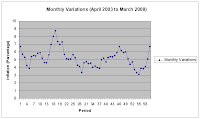
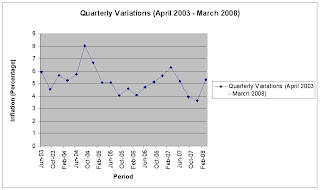
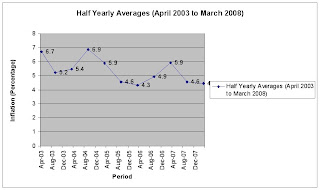
The data on inflation in India during the last 5 years covering the period from 1st April 2003 to March 31, 2008 shows cyclical variations in the inflationary pressures. Data collected relates to monthly closing inflation from which quarterly and half yearly averages where computed to study the seasonal and cyclical variations. The following diagrams show the monthly, quarterly and half-yearly variations of the inflation.

Monthly Variations


The chart shows periodical rise and fall in the inflation. The inflation registered 6.7 % in April 2003, but declined to a level of 3.88% by August 2003. During the period September 2003 to February 2004, it was hovering around 5% and then started increasing to reach a peak level of 8.74% in August 2004. The inflation again came down to reach 3.33 % in August 2005 and varied between 4% and 6 % till it registered 6.69% in January 2007. The last figure 6.68% as on 31.03.2008 is very close to that in January 2007. The latest figure shows that the inflation crossed 7 percent and reached 7.33%.

Quarterly Variations


The quarterly average inflation during the period April 2003 to March 2008 varied between 5% and 5% and 6.5% except the peak level of 8.03 in September 2004. Thereafter, the inflation started declining and reached as low as 3.61% in December 2007 and then climbed up to reach 5.3% in March 2008

Impact of Seasonal Variations
In order to check the impact of seasonal variation, a chart was created using the half yearly averages from April 2003 to March 2008. The diagram below shows the half yearly average inflation. In India we have a busy season commencing from October and ending in March and a slack season from April to September. The chart also was constructed using the corresponding data. Reserve Bank of India announces their Annual Policy in April and Mid Term Review in October every year. These policy documents contain measures for arresting inflation. The chart shows that the inflation rates were coming down or going up after the policy announcements indicating some impact on the policy measures on the inflationary trends. During the one year period from April 2003 to March 2004, the inflation came down by more than 1 percent and reached a higher level of 6.9 per cent. Thereafter it gradually declined to reach a lower level of 4.3 per cent and climbed to 5.9 per cent. Towards the last leg the average inflation came down to 4.6 per cent.


Economists are of the view that the inflation in India has primarily emanated from the supply side and mostly from the pressure exerted by the primary articles. The movement of international price of Crude Oil also contributes in pushing up the inflation. A section of the economists are skeptical about the validity of our price indices because of the base year which is 1993-94, the share of different goods in the basket and the time taken to announce the price movements. Another view is that service sector being one of the emerging consumption segments does not have the deserving share in the basket. Alternatively it can be assumed that the inflation in India is more controlled by the prices of Onions and Potatoes and therefore the monsoon and cropping pattern greatly affect the movement of the price indices.

Conclusion

Inflation indicates the changes in price indices at two different point of time. In India inflation is measured by the movement of Wholesale Price Index. Inflation can be demand-pull inflation or cost-push inflation. Our inflation is more or less demand-pull because the supply side play great role in the movement of prices. The inflation affects the industries because of its impact on the cost of production. Hence managers should be concerned about the inflation and do suitable adjustments to contain the inflation.

BUSINESS AND ENVIRONMENT

Introduction
Every organization exists in a country and operates under certain conditions prevailing in the country. The decisions taken in an organization are influenced by various factors, some of them can be internal and some of them can be external. These factors changes according to the passage of time and the changes have various impacts on the achievement of goals by the organization. In other words, the business organizations function in an environment prevailing in the country which has positive or negative impact on the achievement of result by them.

Dimensions of Business Environment
Business environment can be broadly classified into micro environment and macro environment. Micro environment is the environment prevailing in the organization whereas; macro environment refers to that prevailing in the country. It can also be stated as internal environment and external environment. Another classification is market environment and non-market environment. Just like an individual need an environment conducive for growth, the organizations also need environment conducive to grow and produce results. There are various internal and external happenings which can affect the functioning of an organization. While the internal factors can be controllable or uncontrollable, almost all the external factors are uncontrollable. As such the organization should learn to adapt to the external environment so as to ensure its existence.

Business Management and Macro Environment
As already explained macro environment is external to the organization and beyond their control. This can be domestic environment or global environment. An organization which restricts its business to the domestic country only needs to be concerned with the environment with in the country. If the business is expanded to the other countries also, the global environment also can affect the business growth on account of the global market integration. The example for impact of the global environment on the domestic business entities is the recent sub-prime crisis in US Market. The financial conglomerates like City Group had substantial exposures in sub-prime market and the loan default necessitated them to write off millions. Domestic organizations like ICICI Bank also had similar exposures and had to write off claims. Even State Bank of India had such exposures and they allowed their clients to write off the claims. History tells us such stories of economic crashes like the Latin American Crisis and the East Asian Currency Crisis which were lessons to the business entities across the world. The East Asian Currency crisis led to the collapse of many of the Korean conglomerates due to their inability to meet the claims. Natural Calamities like Hurricane Katrina, Tsunami etc. can also affect the existence of business. The Kobe Earthquake brought down the Nikkei Index which resulted into substantial loss to the 200 old Barings Bank, London due to their over exposure to the Index. There are a number of similar examples where the global environment has affected the business growth.

The domestic environment also affects the business growth. The domestic environment can be politico-legal environment, economic environment and socio-cultural environment. The politico-legal environment refers to the governmental approaches to the business. Such approaches represent the government’s policies and decisions which affect the business favourably or adversely. The politico-legal environment has a number of critical elements such as the form of government, ideology of the ruling party, strength of opposition, role and responsibility of the bureaucracy, political stability, velocity of the government policies and programmes, socio-economic legislations and politico-legal institutions.

The form of government can be a capitalistic form, socialistic form or laissez fare economy. The government can also follow autocracy as in the case of communist countries or democracy as in the case of countries like India. The governments are formed by political parties and the ideology of the political parties leads the government’s policies and plans. If the political party ruling a country is committed against corruption, the business firms will be able to get permissions from the governments easily. For example, in West Bengal, the ruling communist party follows the ideology of industrialization of the state as a result, many industrial units are coming up in the state providing large scale employment to the people in that state. On the other hand the government in Kerala, which is also led by the communist party, nurtures a pro-labour policy; as such the industrialists are less interested to invest in this state. During the last month Kerala lost tons of paddy due to the opposition by the farm workers union led by the communist party against use of machine for harvesting the crop and government’s in action against this attitude. As a result the state had to beg to other states for paddy to feed its masses. If the opposition party is strong they can correct many of the wrong decisions of the government. However, as in the case of Kerala where the opposition is weak, their interferences did not produce much results. Because of this many of the decisions taken by the state government are affecting the business units adversely.

Though the government is led by political parties, the administration is in the hands of bureaucrats. The governmental decisions are implemented by the bureaucracy. In a country where the government controls and regulates the business operations, efficiency of the bureaucracy is very important to ensure timely implementation of decisions. Many of the companies have appointed retired bureaucrats as their liaison officers in order to interact with the government machinery and get things done speedily.

Political stability is another factor which affects the business growth. When the ruling party has the absolute majority, they can continue in the government till the end of the term. On the other hand in the coalition government, any of the constituent parties can pull the government down by withdrawing its support. Therefore, the government may have to dance to the tune of these parties. Unstable government may hesitate to take firm decisions which affect the business units. The decisions will be mostly for pleasing the constituents rather than on economic considerations.
The government may formulate policies with tremendous speed, but when it comes to the implementation part, the process becomes at snail’s pace. For example, in Kerala, we started hearing about Metro Rail Project in Kochi for the last so many years. Though the agreement was also signed by the Metro Rail Corporation for implementation of the programme, the process is now at snail’s pace due to opposition from traders. Similarly, though the government started taking back all the government land from the private owners for expansion of the M.G.Road, Ernakulam and demolished the unauthorized constructions, the project is now in dead-lock. Though policies and projects are formulated speedily, the implementation becomes very slow.

The policies of the government are often enforced through various legal enactments. The socio-economic legislations which govern the business operations constitute the legal environment. The legal enactments which affect the business operations in India are Monopoly and Restrictive Trade Practices Act (replaced as Competition Act), Foreign Exchange Management Act, Industrial Disputes Act, Factories Act etc. Lastly, the functioning of the legislative, executive and judicial actions of the government also affects the business environment. For example, the performance of banks will be affected if the loans are not recovered timely and timely decisions on recovery suits filed by banks affects the recovery performance. Similarly, red tapism affects the functioning of the executive machinery; as a result the decisions on many matters of importance to the industry might be getting delayed.

The economic environment can be macro environment and micro environment. Macro environment is country specific and changes form country to country. These include the operation of economic factors like GDP, National Income, inflation, demand and supply, government’s monetary and economic policies etc. The managers have to interact with the economic environments frequently in order to assess the impact of the variations in these factors on the business performance. For example, a government policy on imposing levy for sugar will affect the sugar manufacturing companies. Similarly during the last six months, the software companies in India are incurring losses on account of appreciating Indian Rupee. The changes in the economic factors affect the purchasing power of the people and therefore influence the demand for products. The micro environment is the organization specific and internal factors. These include a fire in the factory or delay in getting working capital finance from bank etc. An example of micro environment is the closure of Perumbavur based Travancore Rayons Ltd. due to the power shortage and trade union militancy.

Lastly, the socio-cultural environment also plays an important role in the success of any business activity. The business should maintain harmony with the social environment. The critical elements in sociological environment of business are social institutions and systems, social values and attitudes, education and culture, role and responsibility of the government, social groups and movements, socio-economic order and social problems and prospects. Social institutions and systems refer to the social systems like cast, creed, child marriage, joint family etc. The changing social values and attitudes like the change of role of women from house wife to working executives or entrepreneurs also have impact on the business growth. Education and culture is the other factor which influence the business. Growing number of business schools imparting business education, Kerala becoming the 100 percent literate state etc. are examples of changes in the education and culture. The government has a pivotal. The government should be committed to reduce social tension and provide atmosphere conducive for the growth of business. Example for the government’s role is the declaration of special economic zones for promotion of exports, establishment of technological park for development of software industry etc. The development of social movements like communism, trade unionism etc. also affects the business growth. The Kerala State is the best example for such social movements. The communism and trade unionism is adversely affecting the growth of business and industry in this state. Societal pluralism is another factor which affects the business. A society having various religions, culture, language, customs and tradition will turn against the business if any of these are disturbed. People will oppose establishment of a bar hotel near the place of worship or school. Recently, cheer girls were borrowed by the Indian Premier League for dancing in the cricket field, many of the social organsations opposed to it and even the Maharashtra Government threatened to ban the dance in that state. Another critical element is the social problems like the explosive growth of population, unemployment, poverty etc. consequent to the fall in death rate due to better health care system. Some of the African countries like Uganda; Nigeria etc. are suffering due to such problems. The business has to understand the social environment in which it exists and adjust its activities so as to avoid any clash with the social values and systems. The social development, industrialization process and management culture also affected the growth of business. The social developments include the trade union movements, consumer movements etc. While the trade union movements increased the bargaining power of employees, the consumer movement increased the bargaining power of consumers. The traditional system of managing agency which dominated the industrial activities in the country was abolished in 1969 and replaced with participative management, professional management and family owned business. The latest addition to these changes is the entry of multinational companies and foreign companies. Another important development is the changing role of shareholders. The shareholders have now become more powerful which made the corporate management more accountable. The corporate goal has now been re-written as shareholder wealth maximization.

The Environmental movements like Green Peace Activities also play a decisive role in the industrial growth. The responsibility of the business to maintain the ecological balance while expanding their business has increased substantially and the corporate entities are now made accountable for ecological violations. The unscientific usage of natural resources has resulted into its depletion and the large scale industrial expansion became a cause for the environmental deterioration. Some of the major issues the human race now faces are the global warming, industrial pollution, ecological imbalances etc. The rivers have become dry and the ground water resources have been dried up due to the excessive industrial pollution. Another matter of concern is the indiscriminate use of chemicals in industrial processes which caused fatal deceases like cancer. The use Endosulphan in the Northern Districts of Kerala like Kannur, Kazaragode etc. became a controversial issue as the people in the locality was affected by skin deceases. Another example is the industrial pollution created by the erstwhile Gwaliyor Rayons at Mavoor neat Kozhikode. The unit was ultimately closed. Another recent example is the closure of the Coco cola Plant in Plachimada near Palakkad due to the indiscriminate use of ground water which resulted into agitation by the social activitists like Medha Patkar and the local people. . Environmental protection and proper management of the ecology is absolutely necessary for sustainable development. Government has brought out various policy measures to protect the environment. Some of these measures include identification 17 highly polluting industries, prescribing emission norms for vehicles and insistence of compulsory emission testing certificate, drawing up Environmental Action Plan etc. The business also is expected to contribute from their part for the sustainable development. The corporate social responsibility (CSR) has become a globally accepted practice and companies now set apart a portion of their profit for the social benefit. The corporate entities are responsible to their stakeholders and society is one among such stakeholders because the corporate entities are using the resources which would have been otherwise available to the society. Therefore they are bound to return the cost of such resources to the society.

Conclusion
The business is functioning in an environment and has to interact with this environment frequently. The environment can be classified as internal and external environment. The environment can be global environment and domestic environment. The domestic environment can be further classified into economic environment, socio-cultural environment and politico-legal environment. Each of these categories has critical elements. The economic environment can be macro economic environment and micro environment. The critical elements of macro-economic environment are economic systems, nature of the economy, anatomy of the economy, functioning of the economy, economic planning and programmes, economic policy statements and proposals, economic control and regulations, economic legislations, economic trends and structure and economic problems and prospects. The micro-economic factors are organization specific. The critical elements of socio-cultural environment are social institutions and systems, social values and attitudes, education and culture, role and responsibility of the government, social groups and movements, socio-economic order and social problems and prospects. Lastly the critical elements of politico-legal environment are the form of government, ideology of the ruling party, strength of opposition, role and responsibility of the bureaucracy, political stability, velocity of the government policies, plans and programmes, socio-economic legislations and politico-legal institutions. No business can exist by ignoring the environment. There fore the business decision making process should involve the environment analysis also so as to ensure that the decisions do not work against the interest of the environment.